Tampilkan postingan dengan label engine repair. Tampilkan semua postingan

Rabu, 26 November 2014

Checking an engine after head gasket failure


Engines can have head gasket failure in two ways:
  • They can leak oil or coolant onto the ground, with no internal failure
  • The fire ring seal can fail, allowing combustion gases to pressurize the cooling system

Of those two failures the second is by far the worst because it’s usually associated with overheating and sometimes catastrophic engine failure.  The common dealership repair is usually to slap a new head gasket in place and send it down the road.  That works for some engines.  But on others, the result is a repeat failure – a month, a year, or three years later. 

A blown head gasket. Area in the red box is the coolant passage.  The half circle is the combustion seal 
Most of the cars we see are in this latter category.  For example, we get quite a few Land Rover engines that have a “history of head gasket replacements.”  No engine should have repeat head gasket failures.  When that happens, some repair step is being skipped, or there’s another root cause. 

Almost every engine we see needs some additional machine work when the heads come off.  That makes me wonder if the shops who are just slapping in a new gasket are ignoring that and trusting luck, or if we just see the “repeat offenders” because we are more a shop of last resort when the local mechanic could not fix the car.

How can you tell if a gasket alone will fix your problem?  You measure.  Read on, and I’ll show you how we check for problems and what we do when we find them. 

The first things we do are tank clean the head, and then blast it with walnut shell grit to get it as clean as new. Next we measure the head for flatness with a straight edge.  When aluminum heads are removed from an engine, they are usually slightly out of flat.  In addition, they can be corroded.  Sometimes we see damage from coolant gone bad, and we occasionally have to weld that up.  We also see cracks on some engines.  Cracks are typically repaired by welding too.  When all that is done, the surface of the head is machined flat.  If the engine is a V6, V8, or V12 we surface both left and right heads equally so as not to cause a compression imbalance.


Repaired cylinder heads for a Bentley (c) J E Robison Service

If an engine has more than 75,000 miles the heads will always benefit from freshening up.  In that, we reseat the valves, check the guides and fit new seals, and clean the ports. We check for valve seat damage, which will lead to burnt valves.
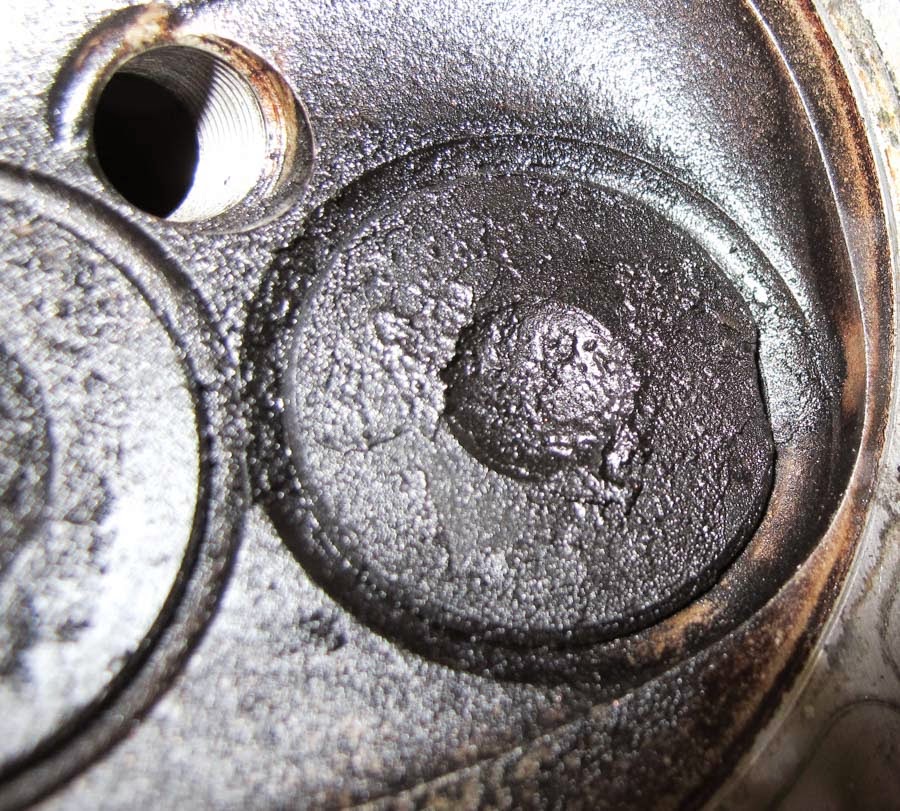
A burnt valve as seen in the head (c) J E Robison Service
Burnt valve removed from the head (c) J E Robison Service
If the owner wants his engine blueprinted we will also measure each combustion chamber’s volume and increase the size of small chambers to match the volume of the largest chamber.  This is typically done by grinding material away and by recessing the valves deeper into the seats.

The heads are the easy part.  Now we check the block.  We use a straightedge to measure the deck surface for flatness.  Sometimes we find broad warping, while other times we find depressions or valleys.  The head gasket can take up a few thousandths of warp, but a block with 5 or 10 thousandths has to be taken apart and repaired.  The reason:  major warpage of the deck often means the bearing journals are warped too, and if that is ignored the engine will have a lower end failure at some point.

Significant deck warping is a sign of major overheating. 

Illustration of a low spot in an aluminum block deck (c) J E Robison Service
The next thing we look for is out-of-round in the cylinders.  We measure the cylinder bore front to back, and inside to outside.  The difference between those measurements is called “egging.”  We don’t want to see more than .002 inch.  More than that and the piston rings won’t seal well, and the engine will use oil and possibly lose compression.  Egging is another sign of overheating.

We also make those measurements at the top and bottom of the cylinder.  Again we don’t want to see more than .002 difference.  Top to bottom difference is called “taper.”  When a motor has too much taper it may know, and that’s a sign it’s worn out.


Measuring cylinders for taper and egging, BMW V8 shown (c) J E Robison Service
Finally, we test the studs or the head bolt threads, particularly on aluminum engines.  We look for evidence of stripped or pulled threads, and we repair any damaged ones with inserts. An insert repair will be stronger than the original in most cases.


Repairing damaged head studs with oversize inserts Bentley V8 shown (c) J E Robison Service
If the block is out of spec in those areas it should be removed and overhauled.  We can fix dimensional errors like that in most cases.  The other thing we look for is corrosion damage.

If you think this sounds like a lot of work compared to slapping in head gaskets, you are right.  The gasket slap is a strategy for dealerships working on factory warranty (where it just has to last to the end of warranty . . .) and new cars (where corrosion and wear are seldom issues)  If you work on older vehicles, or if you want your repairs to be at least as good as original (as opposed to almost as good as original) this is the only path to take.


Quality engine work takes time, and costs money.  Jobs done correctly last, and the price is soon forgotten while poor quality never goes away.  


If you're wondering what's below the heads, read this story about liner failures in Land Rover V8's and how we fix them.

Good luck
John Elder Robison

Robison Service has provided independent service, repair, and restoration for BMW, Land Rover, Jaguar, Mercedes and Rolls Royce -Bentley owners all over New England for over 25 years. Founder John Robison is a long time technical consultant for the Rolls Royce and Bentley Owners Club. Our company is an authorized Bosch Car Service Center. We also service Mercedes, Jaguar, Land Rover, Porsche, and MINI motorcars. We have flatbed transport throughout the northeast region, and we work with Intercity and other transporters for greater distances. We also offer pickup and delivery for cars in  Springfield, Wilbraham, Longmeadow, Agawam, Westfield, Northampton, and Amherst.

Rabu, 05 September 2012

Flanged or Top Hat Liners in Land Rover Engines

The more I see of the 2003-4 Land Rover Discoveries, the more it seems their engines were fatally flawed.  Ten years ago, 90% of the engine problems from overheating were due to heads warping or head gaskets failing.  10% were due to what people called "slipped liners."

The same was true for noise complaints.  When someone came in with a rap or tick issue the problem was almost always a noisy catalyst or worn rocker shafts - comparatively simple fixes.  Only a tiny fraction of noises were from internal motor problems.

Today, with the late Disco motors, those odds have flipped.  When a 2003-4 Rover comes in with overheating trouble, the most likely cause is liner or block failure.  A noise complaint is more likely to be from excess clearance in the piston-liners (in other words, prematurely worn out.)   I've written several essays about how this happens so I won't repeat all that here.  The question is . . . what do we do about it?

The solution that has emerged - both here at Robison Service and in the UK - is to rebuild the blocks using flanged liners so the cylinder head seals against the liner, not the block.  Then we fit new pistons with proper clearances.


The photo above shows a typical failure.  The block cracks at the base of a head bolt bore, between the back of the liner and the water jacket.  With the stock liners there is no barrier to prevent combustion gases going round the liner and into the coolant.

The fitment of flanged liners solves that problem by making the liner top the sealing surface.  There is no high pressure gas behind the liner, and the cracks are rendered irrelevant.


The photo above shows a flanged liner and a new piston.  The o-ring seals the bottom of the liner to prevent coolant dripping into the oil sump in the event of a crack.


This is what a flanged liner looks like installed.  As you can see the wide flange covers the entire sealing area of the head gasket.

We can do flanged liners in 4.0, 4.6, and overbore configurations.  At this moment (Sept 2012), costs to do a block with flanged liners, new pistons, and all basic machine work in in the $4800 price range.  Our American costs are similar to costs from RPI or Turner over in the UK.

We believe this is the only long-term solution to the problems in these late motors, and it provides a substantial upgrade for any older Land Rover V8.  However, the liner repair is just the beginning when it comes to engine overhaul . . .

What else do we do when building a motor?

I recommend balancing any engine.  Motors like these rely on sophisticated engine electronics to achieve smoothness.  That will be considerably improved if the engine is mechanically balanced before assembly.

Front covers and oil pumps have been problematic on these trucks.  The pump gears fracture, and eventually the oil pump fails.  The result - engine failure from oil starvation.  I recommend fitting a new front cover as long as these parts remain available.

Heads are another problem area.  We recommend rebuilding the heads.  This involved walnut shell blasting to get everything spotless, followed by crack test and a check for warping.  Then we fit new guides, redo valves and seats and cut the sealing surfaces perfectly flat.  If you're a perfectionist we can also cc the combustion chambers to ensure each cylinder is exactly equal.


This is a rebuilt head.  As you can see the sealing surface is cut to a mirror finish.  We true these heads to half a thousandth of an inch to minimize the change of gasket failure.

We also rebuild rocker shafts, and swap cams and lifters.  Needles to say, every other part is cleaned and inspected before being overhauled, repaired, or replaced.   That thinking should also extend to the external accessories like the water pump, injectors, and alternator.


We believe the engines we are building now are substantially smoother and better than what land Rover delivered new.

Till next time
John Elder Robison
J E Robison Service
Springfield, MA USA

Here are three articles about internal problems in the V8s:

V8 engine failures - slipped liners and more - from 2009

Should you rebuild a failed Land Rover motor? I have an article about that situation here that covers the decision process

What's the latest on top hat or flanged liners? This article tells all you want to know about the flanged liner overhaul

Discovery II models also have a problem with frame rust.  We first began to see this in the spring of 2014, when we saw several trucks whose rear frames rusted right through over the winter.  These vehicles seemed more vulnerable to rust than the earlier models.  Read this article to find out why, and what you can do about it.

Are you thinking of restoring a Land Rover?  This article shows some of what's involved.  This article explains the difference between repair and restoration, two very different processes.

If you drive a Range Rover Sport or LR3, read this story on differential failures

And if your supercharged Rover is losing power - read this

Programming keys for your Land Rover is here

(c) J E Robison Service

John Elder Robison is the founder of J E Robison Service, independent Land Rover specialists in Springfield, MA.  John's shop has supported Land Rover owners since 1987. They are experienced at all aspects of service, repair, overhaul and restoration.  Find Robison Service online at www.robisonservice.com or on the phone at 413-785-1665.


About the author:

John Elder Robison is the general manager of J E Robison Service Company, independent restoration and Bosch Authorized Car Service specialists in Springfield, Massachusetts.  John is a longtime technical consultant to the Land Rover, Porsche, and Rolls Royce Owner's Clubs, and he’s owned and restored many of these fine vehicles.  Find him online at www.robisonservice.com or in the real world at 413-785-1665


Kamis, 15 September 2011

When engines run too fast, or too lean . . . valves break

Last week, we received a 1990s Range Rover Classic that ran rough and made some noise.  A local garage had changed the plugs and wires, to no avail.  They did a compression test, and found one dead cylinder, with 25 PSI compression.  A normal reading on a truck like this is 175.  That's when the owner decided to ship the rig to us.

We did a leak down test, where we put air into the cylinder through the spark plug hole, to see where it comes out.  Air came out the exhaust as fast as we put it in.  There was only one thing to do - we pulled the head.


We found just what I expected - a burnt exhaust valve.  You can see the two valves in the cylinder head photo above.  The intake is on the left; exhaust on the right.  See the ragged edge on the right side of the exhaust valve?  That's the failure.  Here's the valve, removed from the head:


In this photo the failure is unmistakable.  That was where the story got complicated.  The owner said, "The engine only started skipping after I got the truck back from having a new transmission installed."  I asked why he had the transmission changed.  "It stopped shifting gears," was his reply.  "It stuck in low."

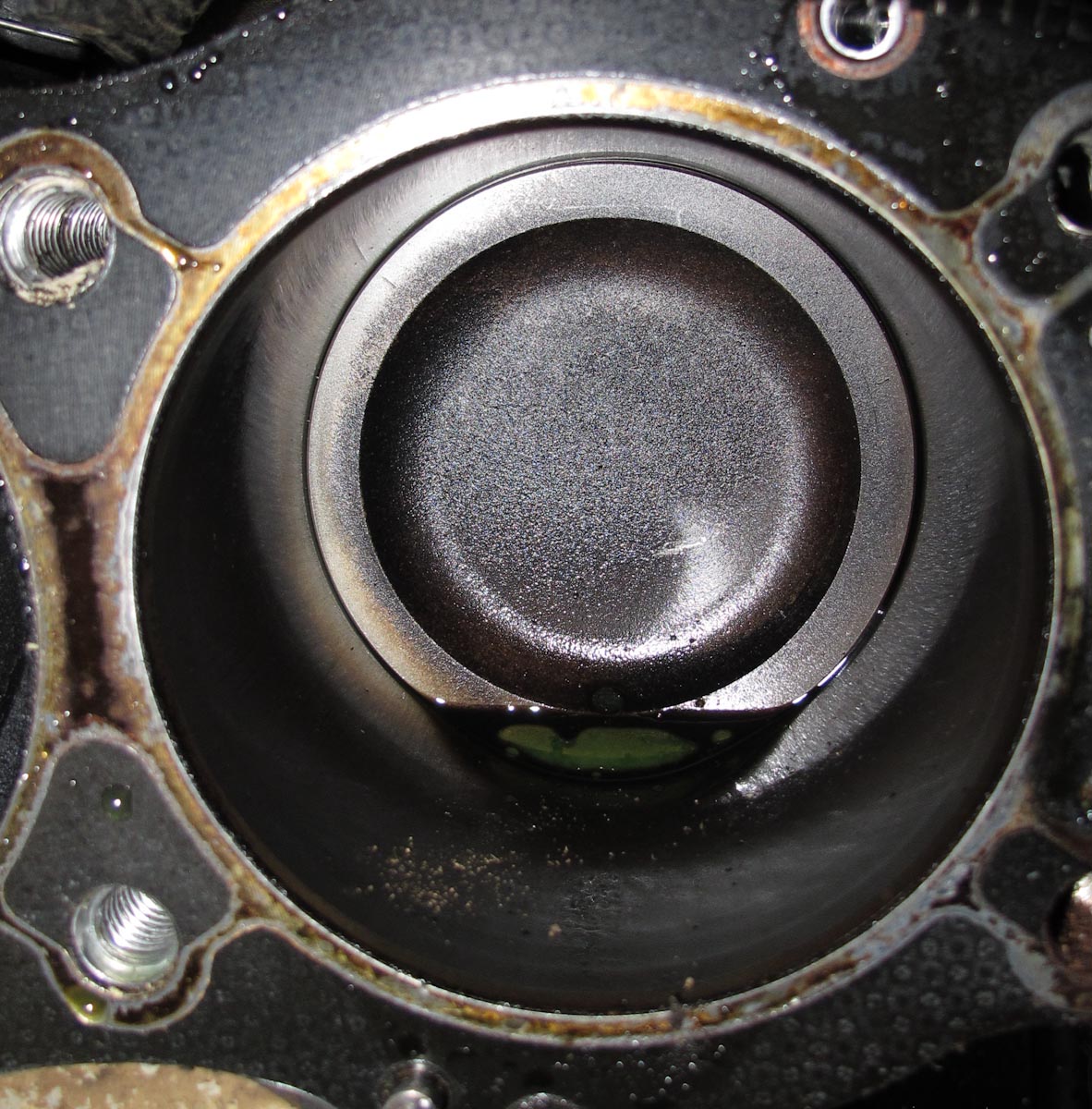
I decided to look at little closer.  Look real close at this photo of the piston.  Note the little line just below center right:


It looks to me like the valve touched the top of the piston, ever so slightly.  BTW, the liquid in the cylinder is residue from disassembly.  It has nothing to do with the repair.

I thought about what the owner had said, and I concluded one of two things must have happened.
A - He ran the engine too fast because the transmission was stuck. As a consequence, the valve "floated" and hit the piston, causing it to fail
B - The engine was racing way too fast with a light load because the transmission was stuck.  As a result, it ran too lean, and the lean running caused that cylinder to overheat because its injector was a little marginal.

I don't know which explanation is correct, and of course one of you readers may suggest something totally different.  For now, I am going to use my best judgement and recommend we change that injector, and fix the valve.  Changing the injector covers both the bases for us.  The trans repair took care of the over-revving, and the injector will take care of possible leanness in that cylinder.

As you can see, there is no sign of damage on the cleaned up piston:


The valve looks just as fried as ever.  We'll fit a new one, and new springs just to be safe.  We will also touch up the valve job on all the other cylinders and clean up the seats.


If you go back to the top photo, you'll see there was black carbon all over the valve.  What does that tell us?  It says someone tried to drive this truck a ways with the failed cylinder.  That suggests it may have failed earlier than the owner thought.  However, it does not change the diagnosis.  

Is there a moral to this story?  I think so. When your car starts to fail, or act at all unusual, park it.  Don't drive it home and then say, "it sounds funny."  By the time you get there, it may be too late.  This fellow started with a transmission repair, but when he kept driving, it became an engine repair too.

In his defense, I must say that we see this all the time. Modern cars have loud stereos and lots of sound deadening around the motor.  Most of the lights and gauges we had 20 years ago are gone.  It's easy to drive today's vehicles until they go up in smoke, and then ask ourselves, "How did that happen?"

As owners (I am an owner too, not just a repair guy) we have to be extra observant because the sounds and smells that used to warn of danger are no longer there for us to see, unless we look real close.  Check your fluids every now and then, and if you ever feel something may be amiss, slow down, open a window, and listen and smell.  It it ticking?  Does it smell hot?  Is that gauge pinned in the red?

In the end, if our cars fail, we pay the price.  So it pays to be vigilant.